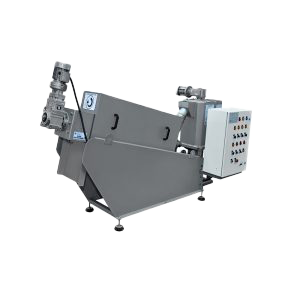

Sludge Treatment Equipment
Sludge Treatment Equipment
Sludge Treatment Equipment…
Belt Filter Press
The belt filter press is capable of separating solids from wastewater in various industries, and the filtration process occurs in two stages: the first stage is gravitational filtration, and in the second stage, sludge is compressed and dewatered between two belt screens guided by rollers.
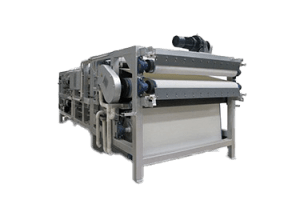
Filter Press Chamber
The filter press chamber is a device designed to separate solids from liquids. Typically, solid particles suspended in a solution are compressed and separated from the liquid after passing through the filter plates. Filter press machines consist of a series of plates, usually made of polypropylene, arranged side by side between two fixed and movable columns. These plates are covered with cloths that have very fine pores, with the material and pore size varying depending on the application. The incoming solution or sludge passes through the plates and cloths, where it is filtered, losing its suspended solids, which are then discharged from the device. The compressed solids, known as the cake, accumulate between the plates of the machine.
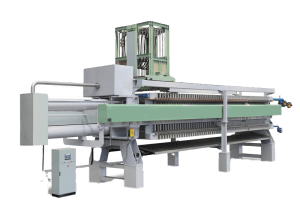
Membrane Plate Filter Press
The plates of these filter presses are diaphragm-type. After the filtration process and cake formation, air is blown into the system, causing the membranes of the plates to expand, applying pressure to the cake and repeating the dewatering process. This results in cake with up to 90% dryness and a shorter filtration time. In this process, the cake does not stick to the plates and can be easily removed during discharge.
Advantages:
Shorter filtration cycles
Shorter cleaning cycles
Lower moisture content of the discharged cake
Uniform cake production
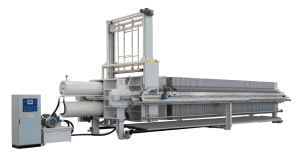
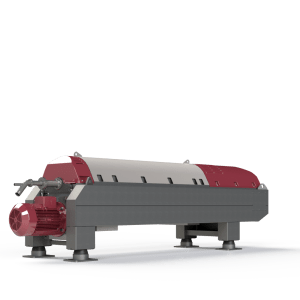
Decanter Centrifuge
In this method, unlike other mechanical techniques, centrifugal force is used instead of pressure to dewater sludge. This system applies a centrifugal force approximately 500 to 3,000 times greater than gravity to the sludge, separating water from the solids. The solids concentration in the resulting sludge cake typically ranges from 15% to 36%, and in advanced systems, it can reach up to 50%. One disadvantage of these systems is the high noise generated by the rapid rotation of their components. Similar to other sludge dewatering methods, chemicals such as polyelectrolytes and lime can be used in centrifuge systems to increase the efficiency of water removal from the sludge.
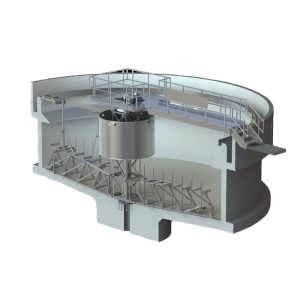
Gravity Thickener
In this method, sludge thickening is achieved by gravity. Raw, mixed, or digested sludge is discharged into the thickener tank through a central cylinder installed in the tank. Gravity thickeners are typically used for thickening primary sedimentation tank sludge, trickling filter sludge, and activated sludge. The degree of thickening in this system can vary between 2 to 5 times the solids concentration of the incoming wastewater.
Belt Thickener
These machines are designed for continuous thickening of municipal and industrial sludge in various sizes and capacities, serving as a replacement for concrete thickening tanks.
Applications:
Primary sludge from wastewater treatment plants
Activated sludge in wastewater treatment plants
Mixed primary and secondary sludge
Digested sludge from wastewater treatment plants
Sludge produced in water treatment plants
Sludge from industrial and paper mill wastewater
Industrial sludge
Sludge from lake dredging
Sand washing plants
Chemical, petrochemical, and oil industries
The belt thickener consists of continuous gravity filters with a belt moving between two rollers, performing the sludge thickening process.
Advantages:
High solids content in the discharged sludge
High operational capacity with low space requirement
Ability to thicken sludge with poor settling quality
Low cost
Easy installation and commissioning
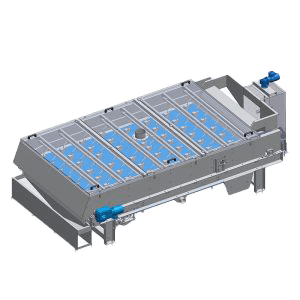
Simultaneous Thickening and Dewatering System
This device enables simultaneous dewatering and thickening of municipal and industrial sludge. Combining the two systems into a single compact unit reduces the required space and lowers operational costs.
Advantages:
Thickening and dewatering of excess sludge in a single step
High solids content in the sludge cake and reduced operational costs
Significant reduction in disposal costs for storage, transportation, drying, and incineration